
Brand ambassador or brand problem?
Jakub Vlášek
In recent years, the word influencer has become a part of everyday communication. They are popping up like mushrooms after rain in all sectors, with new ones appearing daily.
In marketing, it seems that if a brand doesn't have an influencer, it's as if it doesn't even exist. But there is a catch.
Many influencers promote several competing brands at the same time, and consequently, this type of collaboration loses its effectiveness. The reason is that the audience is then unable to associate them with any specific brand.
This is where brand ambassadors come into play. Not those who post for a fee and move on to the next client, but those who truly believe in the brand and are connected to it long-term. While influencers provide reach, ambassadors deliver trust, which no brand can do without nowadays. A well-set brand ambassador program can then be a valuable bonus to a communication strategy – if you know how to do it and what to watch out for.
In this article, we will explain
What brand ambassadorship entails and what the difference is between an ambassador and an influencer.
We will also look at why it can be worthwhile for brands to go down this path, but also what can go wrong.
Many brands tend to completely overlook their most important audience – their loyal customers. It's true that they are not a priority in building brand awareness. However, they have the greatest potential to become brand ambassadors.
What does brand ambassadorship entail?
A brand ambassador is usually a person who knows the given brand, has personal experience with it, and stands behind it even outside of advertising campaigns. They use its products or services long-term, know them inside out, and thanks to this, they can appear exceptionally authentic. This role can look different – sometimes it's a famous face, other times a loyal customer. But what's important is that it's not a random collaboration, but a relationship that makes sense to both parties.
Unlike influencers, ambassadors usually associate themselves with only one brand in a given category. Their main purpose in this regard is not the greatest reach, but depth. Ambassadors have a stronger bond to the brand and are usually involved in a much wider range of activities – from product testing to internal feedback.
The key difference is the overall concept. Influencers can be defined as a certain type of marketing channel, while ambassadors are part of a community. An influencer talks to the audience, while an ambassador is part of it. The audience keeps up with the times and is learning better and better to distinguish whether something is real or just "for show".
And concrete examples? Abroad, it's for example George Clooney and his long-term partnership with Nespresso or Serena Williams for Nike, or Zendaya for Lancôme. In the Czech Republic, examples include Lukáš Krpálek and Under Armour or Klára Vytisková, who has teamed up with several Czech design brands. Users expect authenticity and meaningfulness from brands – and if they feel that the ambassador is just "acting", it loses its effect. And that is why this model is becoming increasingly popular. This is not because it has a greater reach than influencers, but because its impact is deeper and more lasting.
Zendaya for Lancome Idole Fragrance Campaign
Why it (can) work
Let's look at a few of the main benefits that a brand ambassador program can bring to a brand.
Authenticity
One of the greatest benefits of an ambassador program is the already mentioned authenticity. People trust someone more who has known and used the brand long-term. And an ambassador with a powerful story can be more authentic than any claim in a campaign.
Reach
Especially if the ambassador moves within a certain community or has their own network of followers. Ambassadors often connect a brand with people whom standard advertising would not reach. And thus, they can expand awareness in a way that is organic and hard to replicate through classic channels.
Long-term commitment
While a one-off collaboration with an influencer can quickly fade away, an ambassador is here with you longer. They build the brand consistently, across seasons and media.
According to the portal MarketingWeek, ambassadors are not a commodity, but an indicator. If a brand naturally attracts people who want to represent it, it's a signal that it's doing something right. Thus, ambassadors are not just an "advertising face", but a real asset.
What if it doesn't work out?
It all sounds beautiful – a brand finds a person who loves it, and they spread the word further. But reality is usually more complicated. And if the ambassador program is poorly handled, it can harm the brand rather than help it.
Unsuitable choice of ambassador
One of the first and most common fails is the improper choice of ambassador, and it's not just that they don't "fit the feed". The main problem occurs when the ambassador is not aligned with the brand's values – or when their public image attracts unnecessary controversy.
Consistency and trust are key. If the ambassador is perceived as a hired actor rather than a true fan of the brand, the authenticity and effect of the entire collaboration are ruined.
Short-term campaigns without a deeper connection
Ambassadors are not influencers for a one-off story. Worse still, when they follow up with stories for other brands, and at that moment, the ambassador represents multiple brands at once. Some people simply "influence" across brands, but when the same face appears in four different campaigns in a single month, exclusivity and credibility are lost. Especially in a domestic market this small.
So the brand must have an absolute overview of who else the given ambassador is collaborating with. Related to this is another pitfall, namely insufficient control over communication. Yes, authenticity means letting the ambassador speak in their own language. But if the brand does not monitor how the ambassador communicates about it, things can easily go wrong. Without clearly set rules and expectations, it can lead to confusion of the target group or even harm to the brand.
Absence of strategy
Launching an ambassador program without a clear goal, measurable KPIs, or a reasonable plan is a recipe for disaster. Ambassadors must be involved meaningfully – it's not enough to just select them, send a package, and expect miracles.
When it succeeds vs. When it doesn't at all.
Every issue is best described using practical examples. So here we have two stories with the same purpose but diametrically different results.
Serena Williams x Nike
Serena is an American tennis legend. She is a symbol of strength, endurance, and pushing boundaries – and this is exactly what Nike has been supporting and communicating long-term. Within their partnership (which has lasted for over 20 years), they don't just create ads with a standard slogan. They create powerful narratives that resonate – for example, the "Never Done Evolving" campaign, where Nike used artificial intelligence and machine learning to create a simulation of a match between a 17-year-old Serena from 1999 and a 35-year-old Serena from 2017. This campaign highlights her development as an athlete and shows how her game has evolved over the years.
Nike does not collaborate with Serena because she is famous, but because together they tell a story that makes sense to both sides. Authenticity, long-term commitment, natural identification with the brand – this is what it should look like.
Description
Gal Gadot x Huawei
On the other side, we have a famous episode where the connection between the brand and the ambassador went terribly wrong. Actress Gal Gadot, as a brand ambassador for Huawei, promoted the new Mate 10 Pro phone model on her Twitter. The problem occurred when followers noticed that the tweet was sent from an iPhone. The incident spread quickly across social networks and became a subject of both mockery and criticism. Gadot later stated that the post was published by a member of her team, not her. Even so, the entire situation left a digital footprint and pointed to the importance of control over the ambassador's communication.
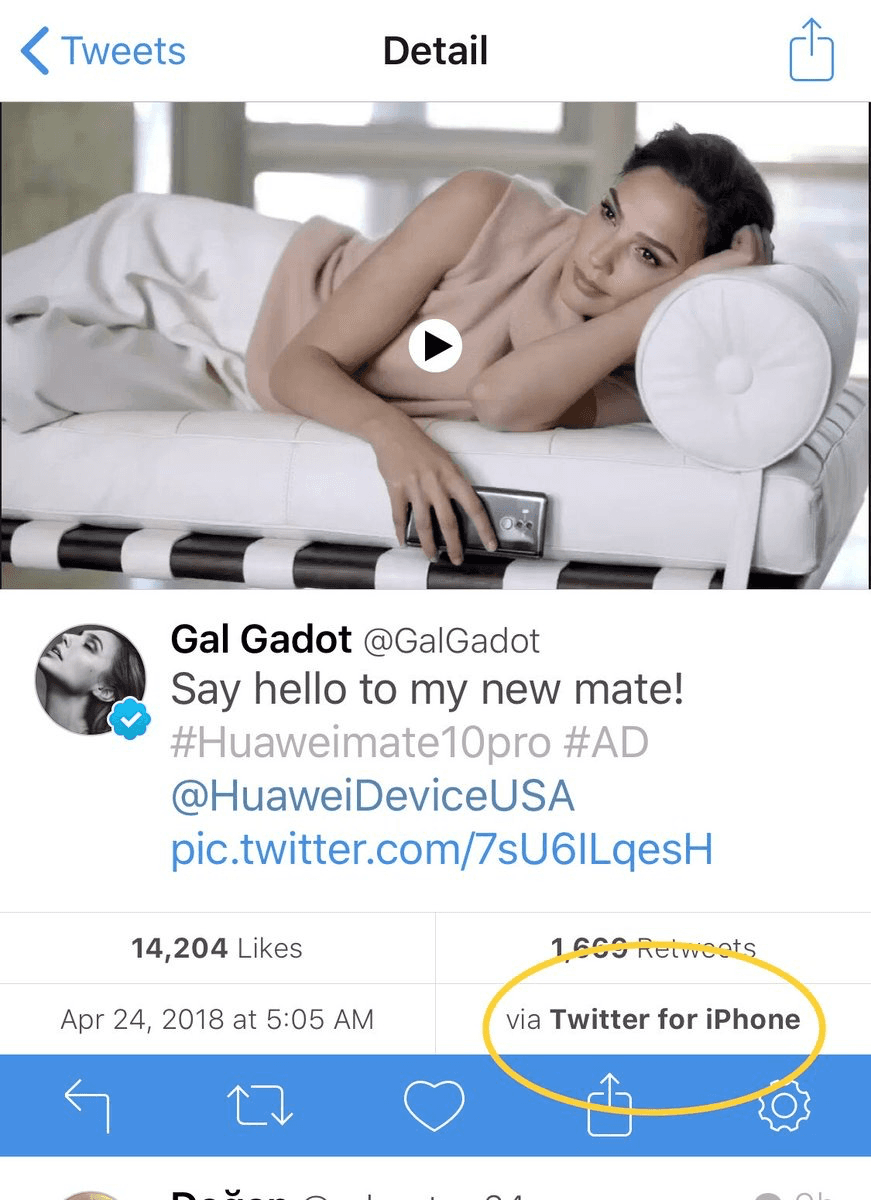
Paid as a brand ambassador by Huawei, Wonder Woman star Gal Gadot tweets from iPhone
Brand ambassador or brand problem?
Collaborating with an ambassador can be a powerful weapon. But only in the hands of a brand that knows what it's doing. Otherwise, it's just another collaboration on social media that nobody remembers a week later. A successful ambassador program requires strategy, long-term commitment, and above all, careful selection of a face that truly believes in the brand and will represent it with naturalness and credibility. As mentioned, ambassadors are an indicator – proof that your brand is doing something right. When it attracts people who want to represent it authentically and of their own free will, the audience accepts them much more easily. If a brand has a clear vision, it starts to attract people who align with it. Not because someone offers them a fee, but because they see themselves in its philosophy. These are people who would use the product even without a campaign – and that is why their support resonates with the audience much more strongly than in the case of regular influencers.
It is necessary to build a relationship with ambassadors, giving them enough space, but also boundaries. Ideally in the long term, because only time will show whether the partnership works outside of seasonal campaigns as well.
An ambassador partnership cannot stand on a name alone. It must be built on a deeper alignment of values, audience, and reality. Otherwise, it can go viral – but for a completely different reason than you wanted.
If you still feel that brand ambassadorship is the right fit for your brand, we wish you the best of luck!
…or better yet, don't do it at all.
If you are just looking for a "quick promo," it is quite likely that your investment in an ambassador won't pay off. A half-baked selection, short-term collaboration, or lack of strategy lead to a loss of credibility rather than building it. In such a case, classic advertising or working with influencers with a clear brief is more worthwhile.


 Download our presentation